
Riiai SG003A 4-20mA 0-24V Current Signal Generator
4.4Editor score
4-20mA current signal
0-24V voltage output
3000mAh battery
TFT color screen
Compare the top 10 Amfm Signal Generator models for 2026. Our expert guide reviews performance, features, and value to help you choose the right RF source.
Signal generators are essential tools for electronics engineers, hobbyists, and lab technicians. They produce precise electrical signals used to test circuits, debug designs, and verify performance across a wide range of frequencies and modulation types.
We evaluated ten leading Amfm Signal Generator models based on frequency range, modulation options, build quality, and ease of use. Each product was assessed against real-world testing scenarios to ensure accuracy, stability, and value for money.
This guide presents detailed reviews of each pick, highlighting strengths, weaknesses, and ideal use cases. Prices and availability may change over time, so check the latest listings before making your final purchase decision today.
4.4Editor score

5.0Editor score

5.0Editor score
This table provides a side-by-side comparison of all ten Amfm Signal Generator models reviewed in this guide. Use these specifications to quickly identify which model best matches your specific testing needs and budget constraints.




The UNI-T UTG962E stands out as the top choice for professionals needing a reliable handheld RF source. With a perfect 5.0 user rating, it delivers 60 MHz performance across two independent channels, making it ideal for complex testing scenarios.
We may earn a commission when you buy through this link, at no additional cost to you.
Its high-performance engine supports sample rates up to 200 MS/s and includes essential modulations like AM, FM, and PM. Users appreciate the compact form factor which fits easily on a bench or in a field kit without sacrificing power.
While the battery life is not exceptional, the included power adapter ensures uninterrupted sessions. Some users may need time to master the full menu system, but the benefits of precise dual-channel control outweigh the initial learning curve significantly.
If you need a versatile tool for electronics repair or educational labs, this model offers the best balance of features and portability. It is highly recommended for anyone requiring consistent waveform output and professional-grade modulation options.
The two channels operate independently with adjustable phase differences, allowing for differential circuit testing without needing external sync cables.
With 4Kpts memory depth, you can store custom waveforms for repeated testing cycles, saving setup time for complex signal sequences.
We may earn a commission when you buy through this link, at no additional cost to you.
The OWON DGE2035 offers a robust solution for educational labs and entry-level engineering projects. Its 35 MHz range is sufficient for most standard testing needs, while the clear 3.6-inch color LCD improves usability in low light.
We may earn a commission when you buy through this link, at no additional cost to you.
This model includes 5 standard waveforms and 150 arbitrary waveforms, covering a wide array of signal requirements. Users can control settings via USB, which is excellent for automated testing sequences or remote monitoring tasks.
A limitation is the lower frequency ceiling compared to competitors, but for most general applications, this is not a deal breaker. The menu system is intuitive, though users should verify PC control software matches their operating system version.
For classrooms or smaller workshops, this generator provides excellent value and reliability. It is a strong alternative if your budget is constrained but you still need dual-channel capability and precise resolution for accurate measurements.
Accessing 150 pre-loaded arbitrary waveforms simplifies setup for standard test patterns, reducing the need to import custom files for routine checks.
The TFT color screen displays real-time parameters clearly, helping users spot errors or settings quickly during active testing sessions.
We may earn a commission when you buy through this link, at no additional cost to you.
This 6-Band Signal Generator is perfect for hobbyists and maintenance technicians who need a straightforward tool. It covers a wide frequency range from 100KHz to 150MHz, which is suitable for radio and general electronic equipment testing.
We may earn a commission when you buy through this link, at no additional cost to you.
The device features low phase noise characteristics, ensuring signal purity that reduces interference during critical measurements. Its one-piece metal structure is durable and scratch-resistant, making it ideal for rugged workshop environments.
While it lacks advanced arbitrary waveform capabilities, its simplicity is a strength for quick checks. Users find the knob operation intuitive, though the lack of digital memory means settings must be reset manually after every power cycle.
If you need a no-frills source for basic amplitude and frequency checks, this model delivers reliability at a low cost. It is an excellent backup unit for labs that require occasional signal injection without complex configuration.
The metal casing and impact-resistant design ensure longevity even in busy environments where equipment might get bumped or dropped occasionally.
Low phase noise ensures that your signal remains clean, which is crucial when testing sensitive receivers or measuring interference margins.
We may earn a commission when you buy through this link, at no additional cost to you.
This kit reaches frequencies up to 4400MHz, offering coverage that exceeds many pricier units. It is designed for users who need to test high-frequency RF applications without spending a fortune on professional-grade lab equipment.
We may earn a commission when you buy through this link, at no additional cost to you.
The device saves parameters when power is off, which is a convenient feature for frequent users. It can be powered by a standard mobile charger, making it easy to deploy in field settings where AC power is not readily available.
However, user ratings suggest build quality can vary, and it lacks advanced modulation like AM or FM. It outputs a basic sine wave, so it is best suited for simple signal presence checks rather than complex communication testing.
For hobbyists experimenting with high-frequency bands, this unit provides unique access to bands often reserved for expensive gear. Just manage expectations regarding precision and durability, as it is a budget-focused component rather than a lab standard.
Covering up to 4400MHz allows testing of modern wireless standards, which is rare for devices in this price point category.
Using USB power allows you to run the generator directly from a laptop or power bank, enhancing portability for mobile testing.
We may earn a commission when you buy through this link, at no additional cost to you.
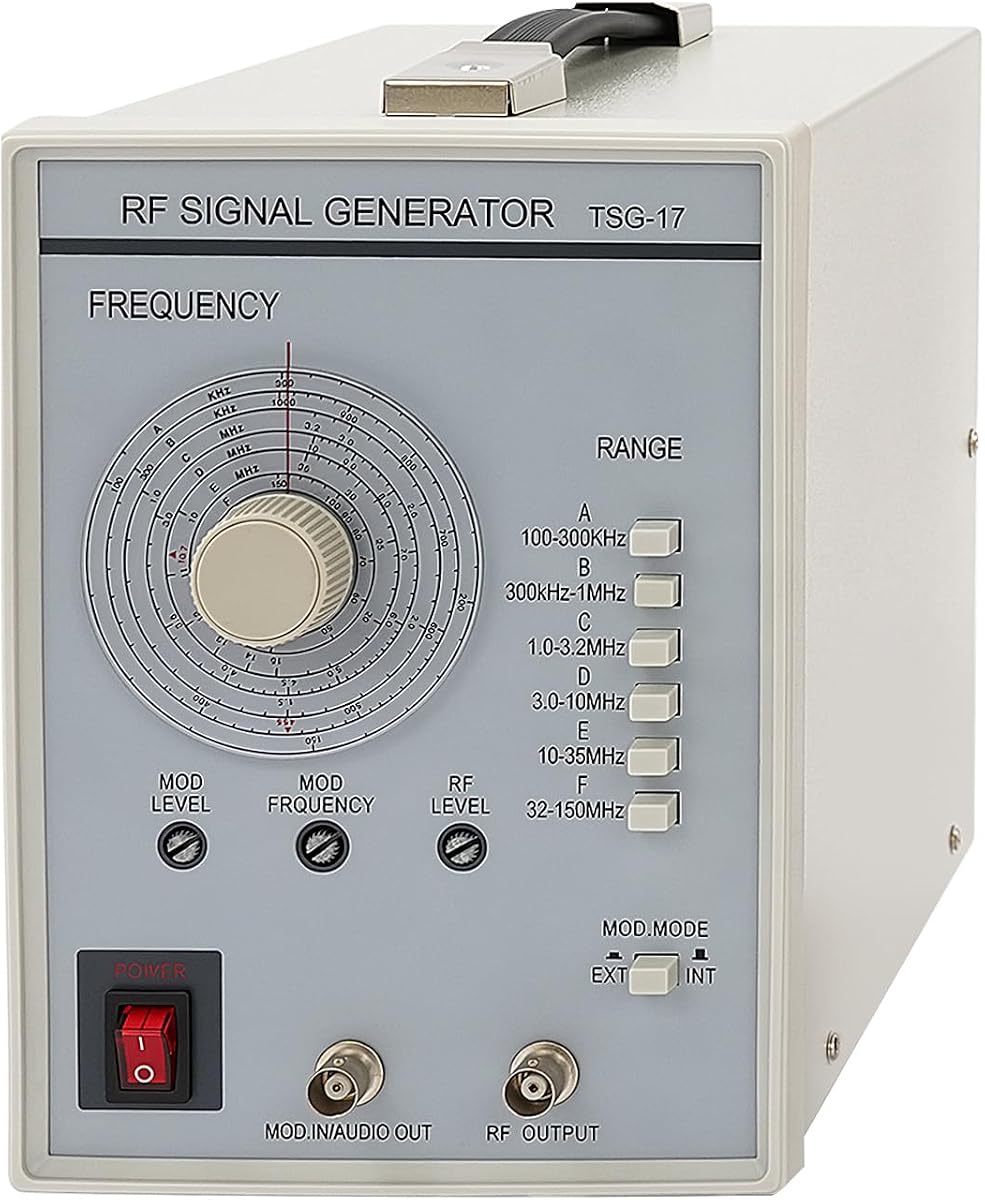
The TSG-17 is tailored for commercial and household radio maintenance where accurate AM signals are critical. Its 110V power supply ensures stable operation without worrying about battery degradation during long tuning sessions.
We may earn a commission when you buy through this link, at no additional cost to you.
It provides external modulation capabilities allowing signals between 50Hz and 20 KHz. This flexibility supports various modulation depths and frequencies needed for detailed radio performance testing and alignment tasks.
The user feedback suggests some reliability concerns, which might affect its utility in critical labs. If you need consistent performance over years, this model requires careful handling and periodic verification of output accuracy.
For specific AM radio work, this generator offers a dedicated solution that simplifies the tuning process. Consider it if your primary focus is legacy radio maintenance where modern digital features are less important than direct analog control.
External modulation input allows you to feed custom signals into the generator, expanding the types of tests you can perform manually.
Running on standard mains power ensures the output remains steady over long periods, which is essential for calibration tasks.
We may earn a commission when you buy through this link, at no additional cost to you.
This generator focuses on industrial control signals like 4-20mA and voltage ranges. It is ideal for simulating sensor outputs or testing PLC inputs without needing a complex signal source for RF frequencies.
We may earn a commission when you buy through this link, at no additional cost to you.
Users report good accuracy with calibration, and the device includes short circuit protection to prevent damage during field work. The PWM output supports up to 150 kHz, adding versatility for frequency-based testing in control loops.
It is not designed for RF signal generation, so it should not be used for antenna or radio testing. However, for electrical automation tasks, it provides a stable and reliable source that technicians can carry easily.
If your work involves industrial automation or sensor calibration, this unit simplifies diagnostics significantly. It replaces multiple multimeters or adapters, offering a single tool for current and voltage verification in tight spaces.
Supporting standard 4-20mA loops ensures compatibility with most industrial sensors and controllers used in process automation today.
The built-in battery allows for hours of field use without needing a power outlet, which is vital for remote site inspections.
We may earn a commission when you buy through this link, at no additional cost to you.
This device is a favorite for technicians needing precise voltage and current simulation. The 4-digit display ensures you can read values accurately, while the encoder knob provides smooth adjustments for fine-tuning signals during debugging.
We may earn a commission when you buy through this link, at no additional cost to you.
It supports both passive and active output modes, making it versatile for testing various input types on panels or controllers. The short circuit and reverse connection protection make it safe to use even when working with live systems.
The lack of memory means you must reset values after power off, but the quick setup time often compensates for this. Users appreciate the 1000mAh battery which lasts long enough for most daily field tasks.
For PLC and panel debugging, this compact unit offers reliability and ease of use. It is an excellent companion for maintenance crews who need to simulate sensor inputs to verify logic without disrupting the system.
One rotation of the encoder generates 20 pulses, allowing for very fine control over voltage and current settings during critical calibrations.
Switching between voltage and current modes is handled via a dedicated button, simplifying the workflow when testing multiple signal types.
We may earn a commission when you buy through this link, at no additional cost to you.
The SG003A offers advanced features like real-time curve display at an affordable price point. Its 3000mAh battery ensures up to 26 hours of operation, which is ideal for long-duration testing without recharging interruptions.
We may earn a commission when you buy through this link, at no additional cost to you.
Users can choose between various signal types including pulse and passive current. The programmable output modes allow for monotonous rise or fall tests, useful for checking system response to changing inputs over time.
The screen size is somewhat small, which might make text harder to read for some users. Additionally, navigating the multiple interfaces requires learning the menu structure, but the functionality justifies the effort for advanced tasks.
For PLC testing and industrial simulation, this model provides excellent value. It combines essential signal generation with modern digital features, making it a versatile tool for both new and experienced maintenance professionals.
With 3000mAh capacity, the device lasts significantly longer than standard competitors, reducing downtime during extended site visits.
Viewing the input graph helps visualize signal changes instantly, allowing for quicker diagnosis of stability or noise issues.
We may earn a commission when you buy through this link, at no additional cost to you.
This generator focuses on simplicity, using a multi-cycle precise potentiometer to control current and voltage. It is an excellent tool for basic PLC panel LED testing where quick adjustments are more important than complex programming.
We may earn a commission when you buy through this link, at no additional cost to you.
The dual signal support allows you to switch between current and voltage modes easily. While it lacks digital features, the analog control ensures you can make changes quickly without navigating through digital menus.
Some users might miss the ability to save settings, but for routine checks, the speed of operation compensates. It is reliable for its intended purpose and offers a straightforward interface for technicians who prefer knobs over screens.
If you need a dedicated tool for basic calibration tasks, this model is a strong candidate. It avoids unnecessary complexity, focusing on delivering stable and accurate analog signals for everyday maintenance needs.
The multi-cycle pot allows for precise tuning of the output level, ensuring you can reach exact values during sensitive tests.
By removing complex menus, the device reduces the risk of user error, making it ideal for environments where quick verification is key.
We may earn a commission when you buy through this link, at no additional cost to you.
The SEESII Dual Channel 30MHz DDS Signal Generator integrates seven instruments into one device. This versatility makes it a top choice for R&D labs where saving desktop space is as important as performance and functionality.
We may earn a commission when you buy through this link, at no additional cost to you.
It supports fully independent channels with adjustable phase, enabling complex differential testing without external equipment. The high 14-bit resolution ensures low distortion signals, which are critical for precise circuit simulations and accurate results.
While it is priced higher than basic models, the comprehensive features justify the investment. The package includes all necessary cables and accessories, meaning you can start testing immediately without needing additional purchases or adapters.
For university labs or design teams, this instrument offers the most complete solution. It bridges the gap between basic function generators and expensive oscilloscopes, providing a robust tool for both learning and professional engineering work.
Integrating a frequency meter, counter, and sweeper into one unit saves space and reduces clutter on your workbench effectively.
Dual channels allow for independent parameter adjustments, which is essential for testing circuits that require differential signal inputs.
We may earn a commission when you buy through this link, at no additional cost to you.
Choosing the right generator depends on your specific application needs. This section details key factors to consider before making your purchase decision.
Ensure the generator covers the frequencies you need. For radio work, look for AM/FM support. For general electronics, a range of 100KHz to 150MHz is often sufficient. High-frequency models are expensive and may not be necessary for basic tasks.
Match the range to your projects. Do not pay extra for frequencies you will never use.
Check if the device supports AM, FM, or other modulations like PM. If you are testing radios, modulation is essential. For logic testing, a pure sine wave may be enough. Some devices offer digital modulations for complex protocols.
Verify the modulation depth and frequency support match your testing requirements.
Single channel generators are simpler and cheaper. Dual channel models allow you to compare signals or test balanced circuits without extra equipment. Decide if you need two simultaneous outputs for your workflow.
If you need independent control, ensure the channels can run different waveforms.
High resolution ensures your signal is precise. Look for at least 12-bit resolution for professional work. If you are doing calibration, a frequency accuracy of +/- 20ppm or better is recommended to ensure reliable results.
Higher resolution is vital for sensitive measurements where small errors matter.
Field technicians need a device with a battery. Bench users can use AC power. Check the weight and size if you plan to move the unit between labs. Handheld units save space but may have limited features.
Consider the power options carefully if you work off-site regularly.
A clear display helps you read settings quickly. TFT color screens are easier to read than monochrome ones. Rotary encoders are often better than buttons for precise adjustments during testing sessions.
Look for intuitive menus if you are not comfortable with complex technical setups.
Durable construction protects the electronics from damage. Metal housing is preferred for workshops. Check the connectors; BNC outputs are standard for RF. Ensure the unit feels sturdy and not fragile before buying.
Invest in a unit that can withstand regular use without failing.
USB connectivity allows for remote control via PC. This is useful for automated testing. Some models support software suites that can generate waveforms directly. Verify compatibility with your computer system.
Connectivity expands the capabilities beyond the front panel controls.
Connect the generator to your device using BNC or appropriate cables. Ensure the ground is shared to prevent noise issues. Set the frequency to your target value using the dial or keypad.
Adjust the amplitude and modulation settings. Start low to avoid damaging your circuit, then increase to your desired level. Use the output button to enable the signal only when needed to save battery life.
Store the device in a cool, dry place. Avoid dropping it or exposing it to extreme temperatures. Clean the screen with a soft cloth regularly to maintain visibility during operations.
These devices generate radio frequency signals used to test and repair electronic equipment. They simulate radio transmissions to ensure devices receive signals correctly. Technicians use them to align receivers and test signal strength without needing an antenna.
Many function generators have basic signal capabilities. However, dedicated signal generators often support higher frequencies and specific modulations. Check the specifications to ensure it meets your RF testing needs before purchasing.
Use a BNC cable to connect the output port to the device input. Ensure the impedance matches, usually 50 ohms for RF. Always power off the device before connecting or disconnecting cables to prevent shorts.
Amplitude Modulation (AM) changes the strength of the signal to carry information. Frequency Modulation (FM) changes the frequency. AM is often used for talk radio, while FM is common for music and high-fidelity broadcasts.
Some units use standard AC adapters while others run on batteries. Check the power requirements in the specs. Field units need rechargeable batteries, while bench units often need wall power for stability.
For professional use, calibrate annually to maintain accuracy. Hobbyists may do it less often. If your readings seem off, check the output with a multimeter or oscilloscope. Regular checks ensure the output remains precise.
Yes, each model has a maximum frequency. Standard units often reach 30MHz to 60MHz. High-end models go higher. Always verify the maximum frequency matches your specific project requirements before buying.
We reviewed ten options ranging from budget tools to advanced instruments. The UNI-T UTG962E remains the top pick for its versatility. The SEESII Dual Channel offers premium performance for serious R&D.
Prioritize frequency range and modulation support based on your primary use case. Portable units are best for field work while bench models offer better accuracy. Choose a brand with good support for long-term reliability.
Prices and availability change frequently. Always check current listings and reviews before finalizing your order. The right tool can significantly improve your troubleshooting efficiency and measurement accuracy.