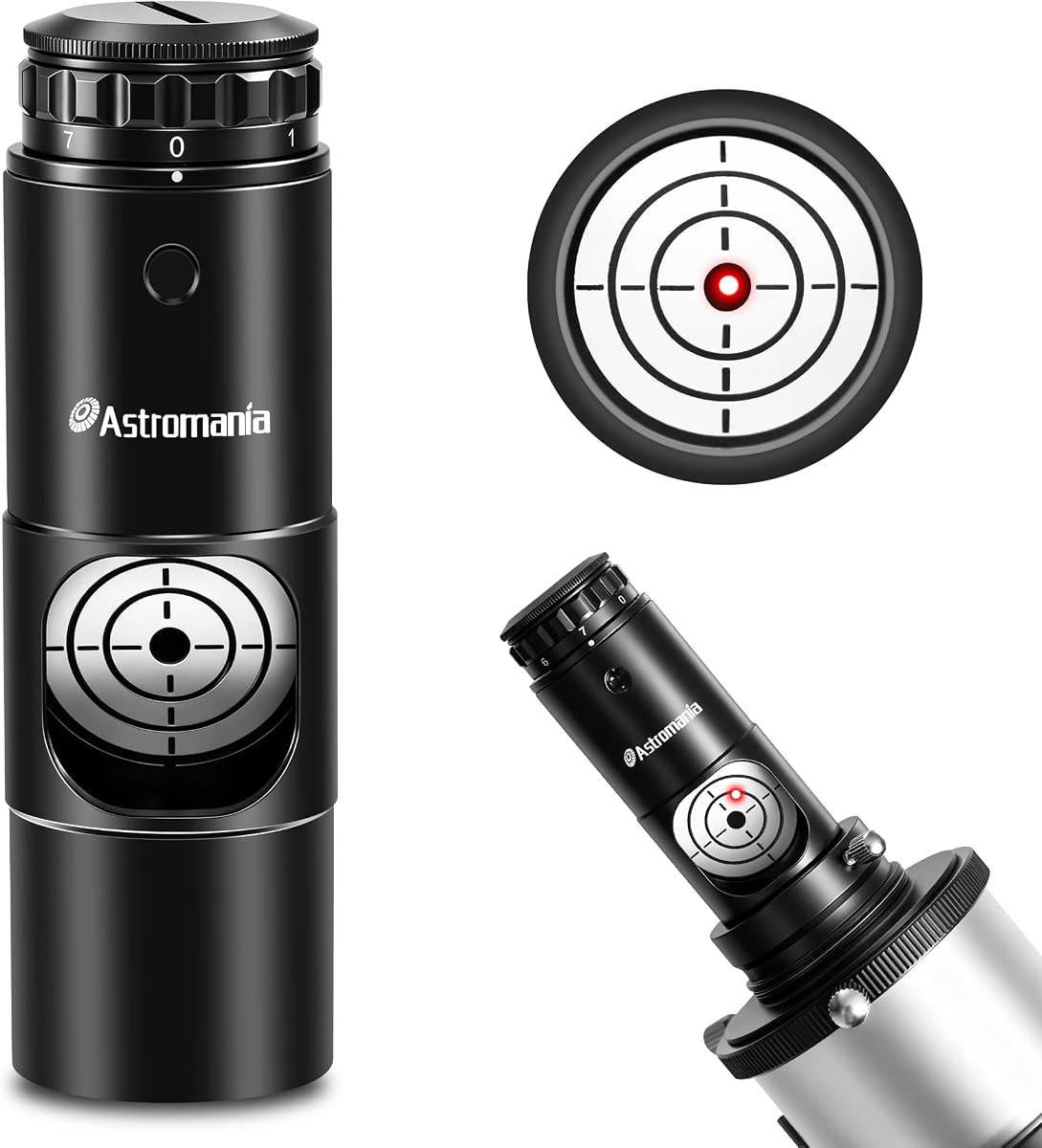
Astromania Laser Collimator 1.25"
4.5Editor score
Seven adjustable brightness levels
Durable metal construction body
Fits standard 1.25 inch focusers
Finding the right laser collimator for telescope alignment is essential for any owner of a Newtonian reflector. Proper alignment ensures sharp stars and clear views across the entire field of sight without blur or aberration.
We have evaluated ten highly rated tools based on build quality, calibration stability, ease of use, and compatibility with standard focusers. Each product offers unique features for beginners and advanced astronomers alike.
Every selection includes detailed specs and pros to help you decide quickly. Note that stock and pricing fluctuate frequently, so always verify current availability before completing your purchase online today.
4.5Editor score
4.7Editor score

5.0Editor score
As an Amazon Associate we earn from qualifying purchases.
Below you will find a side-by-side comparison of all ten laser collimator for telescope alignment products featured in this guide. This table highlights key specifications and features to help you make an informed decision.


This Astromania laser collimator stands out as an affordable yet reliable tool for Newtonian telescope owners. It features a removable 2 inch adapter and seven adjustable brightness levels for use in various conditions.
We may earn a commission when you buy through this link, at no additional cost to you.
Its red laser beam ranges from 635 to 655 nanometers with 3.8mW output, ensuring safe operation. The anodized aluminum body resists wear and tear, making it a solid long term investment.
While it lacks some advanced features like self-centering, it provides precise alignment quickly. The front opening and side window allow you to monitor beam reflection effectively during setup.
Beginners will appreciate the detailed instructions included. If you want a straightforward and budget friendly laser collimator for telescope alignment, this unit delivers strong performance without breaking the bank.
The removable 2 inch adapter lets you use this collimator with both standard 1.25 inch and 2 inch focusers without buying a separate tool.
Seven brightness levels allow you to adjust the laser intensity for different lighting environments, from bright rooms to dark sky sites.
We may earn a commission when you buy through this link, at no additional cost to you.
Designed specifically for 1.25 inch focusers, this Astromania model is ideal for portable kits. It offers swift and precise collimation to help you get sharper views in just a few minutes.
We may earn a commission when you buy through this link, at no additional cost to you.
The body is made of premium metal with an anodized aluminum finish. This ensures durability and resistance to wear and tear, making it reliable for many years of stargazing.
It includes a CR2032 lithium battery for immediate use. The intuitive layout means you can adjust and check alignment without needing a second pair of hands to hold the unit.
If you already have a 1.25 inch focuser and want a compact tool, this is a great choice. It simplifies the collimation process significantly while maintaining professional grade accuracy.
The compact body fits comfortably in your hand, making it easy to carry anywhere whether traveling to a dark sky site or storing in a kit.
Complies with Class 3R laser safety standards with 3.8mW output, ensuring much safer use for your eyes during alignment sessions.
We may earn a commission when you buy through this link, at no additional cost to you.
The SVBONY laser collimator is designed for calibrating reflecting telescopes efficiently. It allows you to easily collimate 1.25 inch and 2 inch reflector telescopes without the need for additional calibrators.
We may earn a commission when you buy through this link, at no additional cost to you.
Its triple cemented lens improves the stability of the red dot, ensuring a consistent beam. This feature is crucial for accurate alignment that remains reliable over time.
Made with a solid metal body, it is built for long term use. The included instructions provide a step by step procedure on how to properly align a reflecting telescope using this tool.
This unit is a great gift for birthdays or holidays. If you need a robust tool that handles both sizes and provides clear guidance, the SVBONY is a strong contender for your collection.
The triple cemented lens design improves the stability of the red dot, which is critical for maintaining accurate alignment during adjustments.
This collimator makes a great Halloween, birthday, or Christmas gift for anyone interested in astronomy and telescope maintenance.
We may earn a commission when you buy through this link, at no additional cost to you.
This bundle includes a user adjustable laser collimator along with a telescope lens eyepiece. It allows you to collimate 1.25 inch and 2 inch reflector telescopes easily with removable adapters.
We may earn a commission when you buy through this link, at no additional cost to you.
The included 62 degree aspheric eyepiece gives a super wide angle view. This allows you to get maximum detail and definition across the entire field of view for an unforgettable experience.
Safety is a priority with this unit, as it complies with Class I laser safety standards. This makes it very safe for eyes while still providing effective alignment capabilities.
If you want more than just a collimator, this bundle offers added value. It suits both field adjustments and mobile astronomy setups where optical performance is key.
The SVBONY 62 degree aspheric eyepiece gives a super wide angle view that enhances your observation experience significantly.
Output power meets Class I laser safety standards, ensuring safety for eyes while you align your telescope optics properly.
We may earn a commission when you buy through this link, at no additional cost to you.
This Alstar laser collimator comes fully adjusted but can be further adjusted if required. It has three openings for adjustment arranged at 120 degrees which are initially sealed to protect internal mechanisms.
We may earn a commission when you buy through this link, at no additional cost to you.
The unit works in all 1.25 inch focusers and comes with precise instructions in German and English. It includes a step by step explanation of how to adjust a telescope using this laser unit.
It features a side window allowing a disk oriented at 45 degrees with a central hole to be viewed. This helps you check if the laser is reflected back on itself accurately.
Built with metal material and using a CR2032 Lithium Cell battery (not included), this tool ensures accurate collimation in a few minutes. It is a simple and effective choice for beginners.
The three openings are initially sealed to protect internal mechanisms from dust and misalignment, ensuring longevity and stability.
A side window with a 45 degree oriented disk helps you monitor laser reflection, simplifying the alignment verification process.
We may earn a commission when you buy through this link, at no additional cost to you.
Achieve precise optical collimation for Newtonian and reflector telescopes with this advanced laser collimator. It features a standard 1.25 inch fit with an included 2 inch adapter for universal compatibility.
We may earn a commission when you buy through this link, at no additional cost to you.
The laser comes pre-calibrated with three 120-degree adjustment openings for fine-tuning. The durable metal construction ensures long-lasting performance and reliability in various environments.
CR2032 battery is required and included in some bundles. The triple cemented lens provides stable beam projection while the front emission opening and 45-degree side window allow accurate reflection monitoring.
Suitable for beginners and experienced astronomers alike, this tool delivers clearer telescopic images through proper alignment. It works with all standard 1.25 inch focusers and reflector telescopes.
The triple cemented lens provides stable beam projection, which is essential for consistent and accurate collimation results.
Effortless operation allows for single person telescope calibration within minutes, making it easy to use without help.
We may earn a commission when you buy through this link, at no additional cost to you.
This SVBONY bundle includes a user adjustable laser collimator plus a cell phone adapter. The phone adapter supports eyepiece diameter from 25 to 48mm and 1.25 inch telescope without fitting 2 inch eyepieces.
We may earn a commission when you buy through this link, at no additional cost to you.
The phone clamping features an adjustable locking mechanism with a steel bolt. Your phone is protected by high density EVA pads during use. It fits various mobile brands like iPhone and Samsung Galaxy.
The laser collimator allows anyone to easily collimate 1.25 inch and 2 inch reflector telescopes. It features 7 brightness levels adjustable for different light conditions for better alignment results.
If you enjoy capturing images, this bundle supports smartphone imaging needs. It makes alignment no longer boring and time consuming with its user adjustable laser and versatile adapter options.
Compatible with most mobile phones and optical devices, this bundle helps you capture images without needing specialized camera adapters.
High density EVA pads protect your phone from scratches and damage when clamped onto the eyepiece adapter securely.
We may earn a commission when you buy through this link, at no additional cost to you.
This bundle includes the SV197 cheshire collimating eyepiece along with a red laser collimator. The Cheshire eyepiece fits for Newtonian and SCT reflector telescopes and is useful for aligning refractor optics accurately.
We may earn a commission when you buy through this link, at no additional cost to you.
It is precision machined from aluminium with fine crosshairs and a clear bright mirror with sighting hole. This makes alignment easy and does not require batteries, making it ideal for daytime alignment.
The laser collimator allows anyone to easily collimate 1.25 inch and 2 inch reflector telescopes. It features 7 brightness levels adjustable for different light conditions for better alignment results.
For a complete alignment solution, this bundle covers all bases. It is designed for calibrating reflecting telescopes with high quality materials and versatile functionality.
The SV197 Cheshire eyepiece offers precise alignment for Newtonian and SCT telescopes with fine crosshairs and a clear mirror.
The Cheshire eyepiece does not need batteries, ensuring it works reliably during the day without worrying about power levels.
We may earn a commission when you buy through this link, at no additional cost to you.
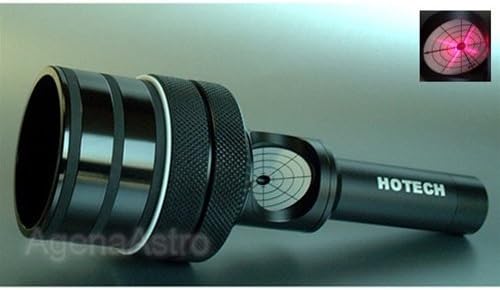
This HoTech laser collimator stands out for its innovative self-centering adapter technology known as SCA. It solves the problem of slop in the adapting mechanism between the collimator and focuser.
We may earn a commission when you buy through this link, at no additional cost to you.
The mechanism allows precise and repeatable installation in all brands of 1.25 inch and 2 inch telescope focusers. This avoids the critical issue of off-axis installation that destroys precision.
It includes a 1.25 inch SCA Laser Collimator with built-in Self-Centering Adapter pre-installed in a 2 inch to 1.25 inch SCA adapter and one CR123 battery. Users also receive manuals for Newtonian SCT and Star collimation.
If you need top tier precision, this is the choice. It separates itself from other collimators in the market by addressing the fundamental alignment gap issue completely.
The SCA mechanism allows precise and repeatable installation, eliminating the slop common in standard adapter systems.
Unlike methods that use thumbscrews or compression rings, this prevents off-axis installation which can destroy collimation precision.
We may earn a commission when you buy through this link, at no additional cost to you.
Elevate your astronomy experience with the Ocal Pro V4.0 Electronic Collimator. This cutting-edge tool is designed specifically for Newtonian and Schmidt Cassegrain telescopes with versatile mounting options.
We may earn a commission when you buy through this link, at no additional cost to you.
Its built-in software-guided calibration circles enable quick and precise optical axis adjustments. Factory-centered to pixel-level accuracy, it ensures you start with optimal baseline accuracy every time.
The all-in-one design allows for complete collimation functionality on-the-go. It is perfect for field adjustments and mobile astronomy setups where reliability and precision are paramount.
Whether you are preparing for a critical imaging session or fine-tuning your telescope performance, this delivers professional-grade capabilities. It is a user-friendly package for those seeking advanced technology.
Each unit comes factory-centered to pixel-level precision, ensuring you start with optimal baseline accuracy without manual calibration.
The portable all-in-one design allows complete collimation functionality on-the-go, ideal for field adjustments and mobile setups.
We may earn a commission when you buy through this link, at no additional cost to you.
Selecting the right laser collimator for telescope alignment depends on several technical and practical factors. Here are the key considerations to ensure you buy a tool that meets your needs.
Ensure the collimator matches your telescope's focuser diameter. Most models support standard 1.25 inch or 2 inch fittings. Some come with removable adapters for both sizes, adding versatility to your kit.
Always check if your focuser is standard 1.25 inch or 2 inch before purchasing to avoid fitting issues.
Look for units that comply with safety standards like Class 3R or Class I. Safe power levels around 3.8mW to 5mW protect your eyes while providing a bright enough beam for alignment tasks.
Prioritize models with clear safety certifications to prevent eye damage during use.
Adjustable brightness is a major plus. Models with seven brightness levels let you adapt to different lighting conditions, from dark skies to bright rooms, ensuring the dot remains visible without glare.
Select collimators with adjustable brightness to suit varied observing environments effectively.
Durable metal construction like anodized aluminum resists wear and tear. A solid body ensures the collimator remains sturdy and precise over years of use in field conditions.
Choose metal over plastic for long-term reliability and stability during collimation.
Precision engineering ensures the laser maintains calibration. Look for units that promise consistent results without frequent recalibration to save time during setup.
Prioritize collimators known for stable calibration to avoid frequent adjustments.
Features like side windows or viewing ports help monitor beam reflection. Simple adjustment mechanisms and clear instructions reduce the learning curve for beginners new to alignment tasks.
Opt for models with user-friendly features and clear instructions for faster setup.
Check if batteries are included or replaceable. Common types like CR2032 or CR123 are easy to find and replace. Long battery life reduces interruptions during critical observing sessions.
Ensure easy battery access and availability to avoid downtime during use.
Prices vary from affordable budget models to premium electronic collimators. Balance your needs with cost to find a unit that offers the best value without compromising on essential accuracy features.
Set a budget that balances cost with the level of precision you require.
Start by inserting the collimator into your telescope's focuser and securing it gently. Do not overtighten the thumbscrews or rings as this can cause the beam to drift off axis.
Turn on the laser and look at the secondary mirror. Adjust the screws until the laser dot centers perfectly on the primary mirror's center spot, ensuring a clear path for light.
Store the collimator in a protective case when not in use. Keep it away from extreme temperatures and impacts to maintain calibration and extend the device's lifespan.
A laser collimator for telescope alignment helps align the optical elements of your reflector telescope. Proper alignment ensures stars appear sharp and images are not distorted. It simplifies the process compared to traditional methods.
Yes if it complies with safety standards like Class 3R or Class I. Always avoid looking directly into the beam for extended periods. The power output is generally low enough for safe use.
Ideally before each observing session if you transport your scope. Frequent handling can shift alignment. If the telescope stays in a fixed location, check it monthly or after any impact.
Yes some models feature multiple brightness levels that work well in daylight. However, using a Cheshire eyepiece is another day option. Check your unit's brightness settings for best day use.
The difference lies in the barrel size that fits your focuser. 1.25 inch is standard, while 2 inch supports wider optics. Some collimators come with adapters to handle both sizes.
High quality models stay calibrated for years. However, if you drop it or notice beam drift, you may need to adjust it. Look for collimators with sealed adjustment ports to minimize drift.
Electronic collimators offer digital precision and calibration circles but cost more. Traditional laser collimators are simpler and often sufficient for visual use. Choose based on your budget and needs.
Most laser collimators are designed for reflectors like Newtonians. Refractors are typically aligned at the factory. Some bundles include Cheshire eyepieces that help align refractor optics accurately.
Choosing the right laser collimator for telescope alignment transforms your views by ensuring optical precision. The ten options reviewed cover a range of budgets and technical needs for all skill levels.
Prioritize features like focuser compatibility, laser safety, and build durability when selecting a tool. A solid metal construction and adjustable brightness will enhance your experience significantly.
Always verify current stock and availability before ordering. Prices and bundles may change, so check the official product pages for the most up to date information.