
SUNLU High Toughness Resin
4.7Editor score
High toughness
Low shrinkage
Widely compatible
This guide compares the top flexible resins for 3D printing, evaluating hardness, impact resistance, and print quality to help you choose the best material for
Flexible resin for 3D printing allows makers to create parts that bend, stretch, and absorb shock without breaking. These materials bridge the gap between rigid plastics and rubber, enabling functional prototypes and durable end-use parts for various applications.
We evaluated ten leading flexible resins based on Shore hardness, elongation at break, printing speed, and post-processing requirements. Our analysis covers products from top brands like ANYCUBIC, SUNLU, and Siraya Tech to ensure you find the right balance of softness and strength.
Each pick highlights specific strengths such as impact resistance, low odor, or high precision. Note that product availability and pricing change frequently, so verify details before purchasing. This guide helps you navigate the options to select the ideal flexible resin for your needs.
4.7Editor score
4.7Editor score
4.2Editor score
The following table provides a side-by-side comparison of the top ten flexible resins, highlighting their key specifications and ideal use cases to streamline your decision-making process.



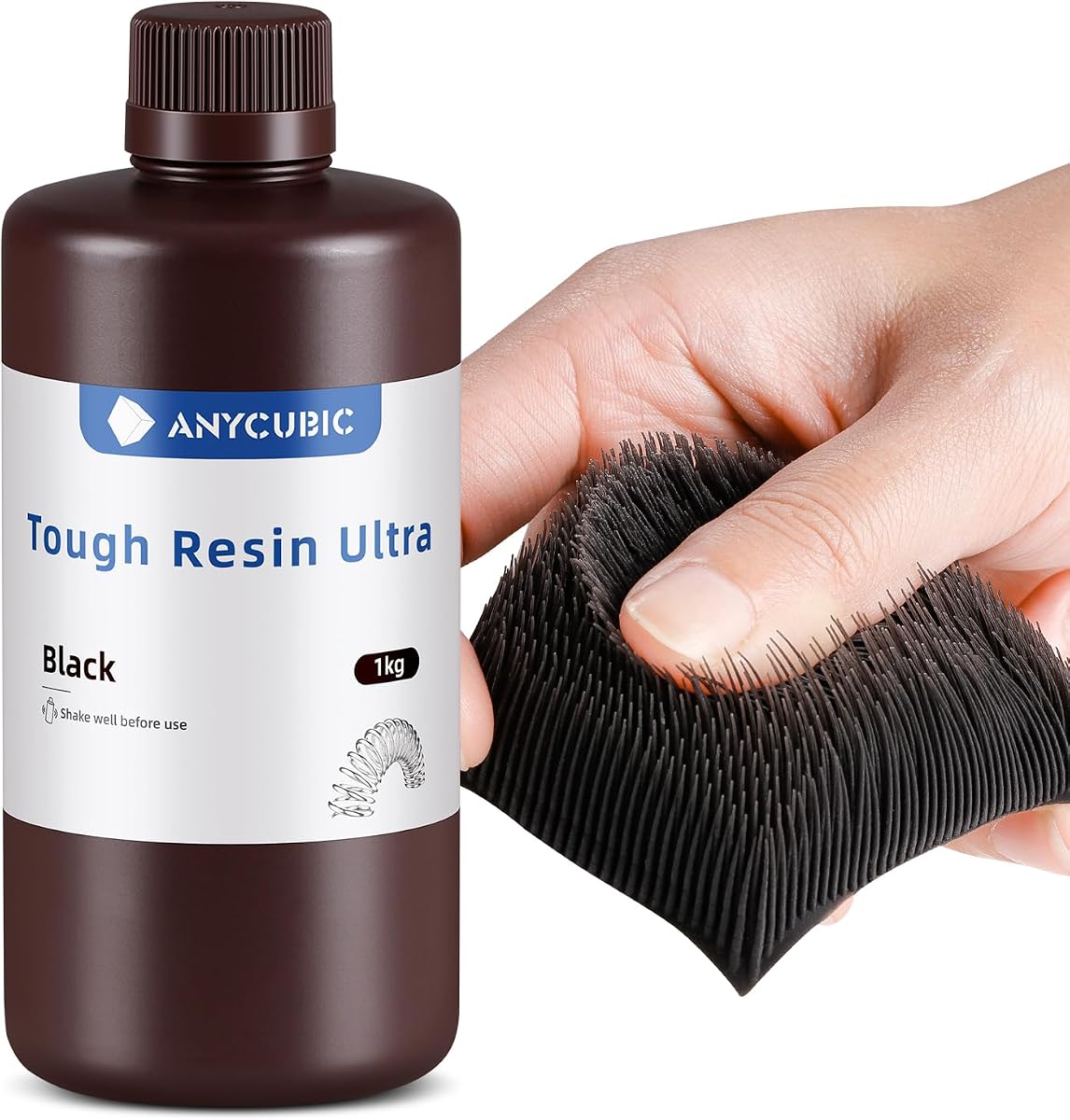
ANYCUBIC Ultra Tough Resin stands out with a 4.7 rating, offering outstanding toughness and flexibility. Its ability to recover shape after deformation makes it ideal for durable, functional prints.
We may earn a commission when you buy through this link, at no additional cost to you.
This resin excels in precision and versatility, enhancing sharpness in hair-like textures and facilitating seamless movement in articulated models. The gentle skin sensation upon curing allows for comfortable wearables like earphone covers.
While blending with other resins can affect final color, the durability and adaptability in extreme temperatures are notable trade-offs. It resists brittleness and corrosion, ensuring long-lasting performance in various environments.
Choose this resin if you need high flexibility and impact resistance for daily wearables or detailed models. Its robust performance justifies the investment for serious makers.
The resin swiftly recovers its original shape following deformation from external forces, ensuring heightened resistance to damage.
Upon curing, it ensures a non-irritating experience on the skin, offering enhanced flexibility for a superior touch and feel.
We may earn a commission when you buy through this link, at no additional cost to you.
SUNLU High Toughness Resin achieves a 4.7 rating by offering long-lasting toughness and elongation five times higher than standard resins. It is designed for unbreakable, durable 3D printed models.
We may earn a commission when you buy through this link, at no additional cost to you.
Its low viscosity and high flowability result in shorter curing times and easier model formation. With lower shrinkage, the potential for distortion is reduced, allowing for crisp, vivid details.
While color choices may be limited compared to other brands, the focus on stability and low odor enhances the printing environment. Cleaning is straightforward with alcohol or ethanol.
This resin is perfect for structural parts and solid models where durability is key. Its balance of affordability and performance makes it a top budget choice.
The resin has excellent flexibility and bendability, making your 3D printed models unbreakable and durable.
Lower shrinkage reduces distortion, allowing you to achieve best-in-class accuracy and display crisp details.
We may earn a commission when you buy through this link, at no additional cost to you.
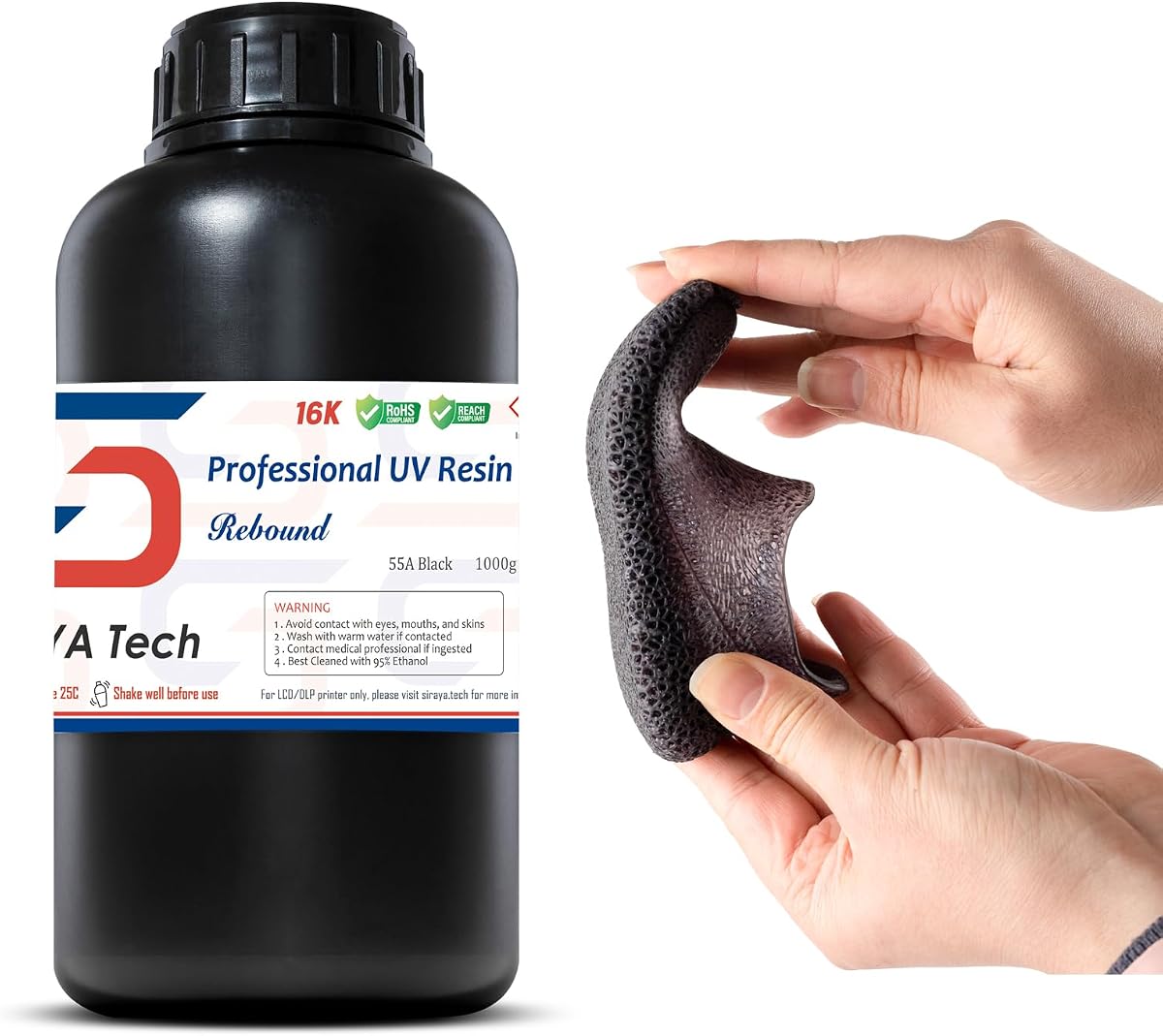
Siraya Tech Rebound 55A offers high elasticity with a 4.2 rating, providing faster rebound than standard elastic resins. It is ideal for applications requiring quick shape recovery.
We may earn a commission when you buy through this link, at no additional cost to you.
The 55A Shore hardness balances flexibility and structural integrity, softer than Tenacious Flex while maintaining excellent compression properties. It prints easily on standard LCD and DLP printers without complex processing.
Initial testing shows good resilience, though long-term performance testing is ongoing. The price reflects its premium capabilities for specialized prototyping needs.
Select this resin for shock-absorbing components and industrial prototyping where rebound performance is critical. Its ease of use simplifies the workflow for advanced users.
Provides significantly faster rebound than standard elastic resins, making it excellent for quick shape recovery.
Unlike other elastomers, it prints on standard printers and cleans with standard isopropyl alcohol methods.
We may earn a commission when you buy through this link, at no additional cost to you.
Superflex 3D Printer Resin features a 4.4 rating with fast printing capabilities, completing 50um layers in 1.7 seconds. It enhances productivity for 3D printing farms significantly.
We may earn a commission when you buy through this link, at no additional cost to you.
With 80A Shore hardness and 100% elongation, it simulates rubber for cushioning and shock absorption. It passes ISO 10993-5 tests when properly cleaned and cured.
The main trade-off is the clear color limitation and the need for thorough post-curing. However, the speed and balanced properties are beneficial for hard flexible prototypes.
Ideal for projects needing rapid prototyping and shock absorption, this resin is a strong choice for efficiency-focused users.
Printing 50um layer in 1.7 sec with monochrome LCD printers saves time and electricity.
Balanced softness and strength simulate rubber for hard flexible 80A Shore prototypes.
We may earn a commission when you buy through this link, at no additional cost to you.
SUNLU Flexible Resin has a 3.5 rating, offering a balance of softness and strength with 70A Shore hardness. It provides a smooth, high-resolution surface finish for flexible items.
We may earn a commission when you buy through this link, at no additional cost to you.
Its low shrinkage ensures accurate size and shape, while minimal odor makes it pleasant to use. It is compatible with 99% of LCD, DLP, and SLA printers on the market.
While the rating is lower than competitors, the stability and compatibility are solid. The leak-proof bottle design adds convenience for transportation and storage.
This resin suits general flexible printing needs where impact resistance and smooth finishes are desired without premium features.
Offers a high-resolution, smooth surface finish resulting in a dry, non-sticky surface with a pleasant touch.
Compatible with 99% of printers on the market, including LCD, DLP and SLA.
We may earn a commission when you buy through this link, at no additional cost to you.
Siraya Tech Tenacious Flex Black has a 4.7 rating, being softer and more rubber-like than classic Tenacious resin. It offers faster rebound and incredible elasticity for resilient prints.
We may earn a commission when you buy through this link, at no additional cost to you.
It withstands extreme bending and compression quickly returning to its original shape. It is also an excellent resin additive to boost impact resistance in other resins.
The 500g size and black-only option are limitations, but the superior elasticity is a strong advantage. It is perfect for projects requiring high flexibility.
Use this resin for soft grips, gaskets, and shock-absorbing components where dynamic flexibility is essential.
Withstands extreme bending and compression, quickly returning to its original shape with superior elasticity.
Exceptional impact resistance ensures that accidental drops do not cause deformations or cracks.
We may earn a commission when you buy through this link, at no additional cost to you.
ANYCUBIC Tough Resin 2.0 scores 4.6 with upgraded high toughness and precision. It reduces the likelihood of breakage for delicate components and thin models.
We may earn a commission when you buy through this link, at no additional cost to you.
It features a low-odor formulation that reduces volatile organic compounds, making it an environmentally friendly choice. High precision and minimal shrinkage ensure smooth surfaces.
The grey color may be a limitation for some users, but the performance in industrial applications is significant. Models are less prone to breakage when dropped.
Choose this resin for high-strength model production and engineering prototypes where toughness and precision are required.
Undergone a comprehensive upgrade in flexural strength, demonstrating enhanced toughness and less prone to fracture.
Boasts excellent precision while maintaining a low shrinkage rate for smooth surfaces and clear details.
We may earn a commission when you buy through this link, at no additional cost to you.
ELEGOO Tough Resin has a 4.5 rating, offering excellent flexibility and extraordinary resilience with a Shore hardness of 84.7D. It withstands certain tension and stress without breaking easily.
We may earn a commission when you buy through this link, at no additional cost to you.
Its fine texture and weather resistance make it suitable for high-performance models even in humid environments. The low odor ensures a comfortable printing environment.
The hardness level may be higher than some flexible resins, but the damage resistance is notable. It can be used for tools, jigs, and functional prototypes.
This resin is ideal for makers needing durable prints with high strength and resistance to brittleness or corrosion.
The cured resin has a Shore hardness of 84.7D, exceeding that of others for better damage resistance.
Shows excellent resistance to brittleness and corrosion even in high humidity or humid environments.
We may earn a commission when you buy through this link, at no additional cost to you.
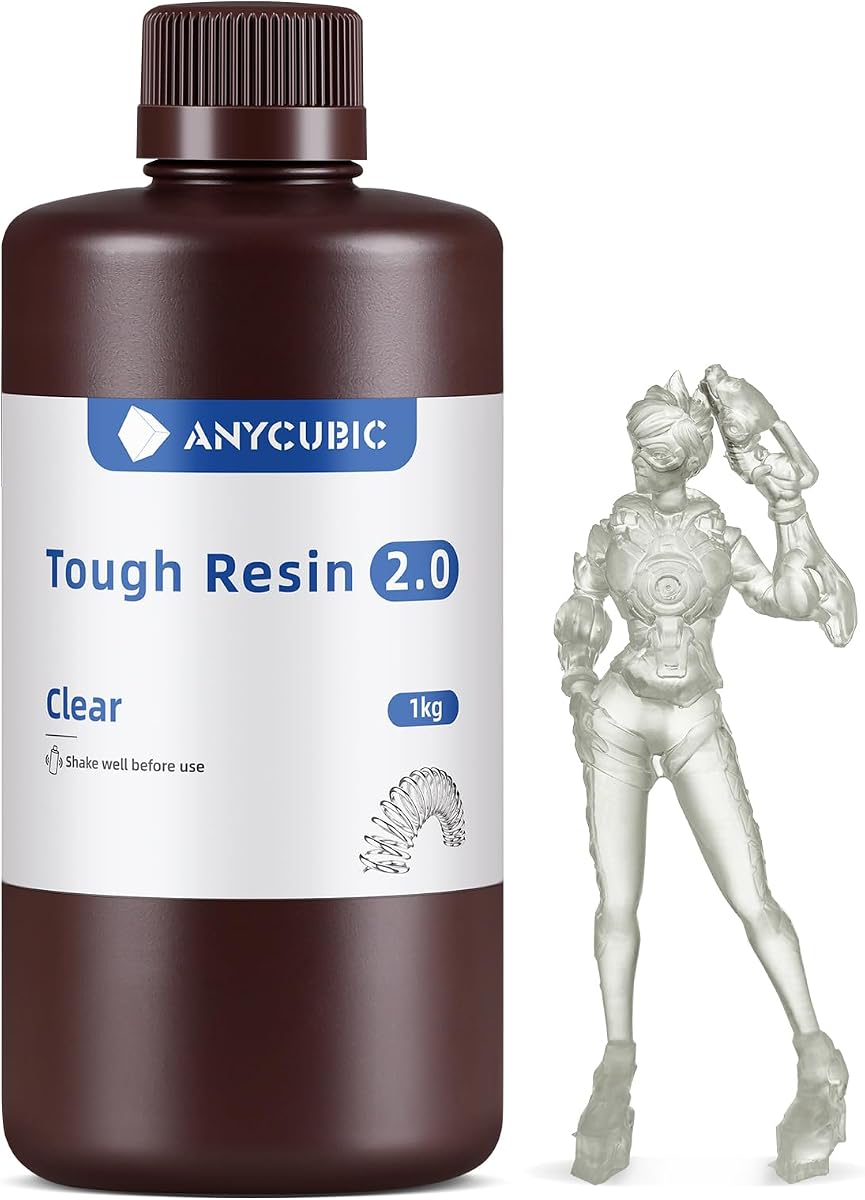
ANYCUBIC Tough Resin 2.0 Clear has a 4.6 rating, achieving enhanced flexural strength and exceptional stretch. It is compatible with various LCD/DLP/SLA printers.
We may earn a commission when you buy through this link, at no additional cost to you.
Its low-odor composition creates a serene printing environment, cutting down volatile organic compounds. High precision and minimal shrinkage ensure high-quality prints.
The clear version is ideal for applications requiring transparency, though it shares features with the grey variant. Models are less likely to break even when dropped.
Use this resin for industry-wide applications where clarity and toughness are both necessary for functional parts.
Achieved a significant enhancement in flexural strength, significantly reducing the likelihood of breakage.
Offers versatile industrial applications and is highly compatible with different equipment and materials.
We may earn a commission when you buy through this link, at no additional cost to you.
Flexible Resin 90A has a 4.4 rating, simulating rubber toughness with 90A Shore hardness. It can be folded and bent repeatedly without breaking, making it ideal for shock absorption.
We may earn a commission when you buy through this link, at no additional cost to you.
It delivers high elongation and excellent tear resistance for real-world use like gaskets and protective cases. High precision and low odor make it comfortable for workshop printing.
The 90A hardness is less flexible than 80A, but it offers good tear resistance. It handles it all from cosplay props to medical models.
Choose this resin for parts that need to stay flexible under stress while remaining tough enough not to rip.
90A Shore hardness can simulate the toughness of rubber, with both softness and strength.
Works great on most LCD and DLP printers, handling everything from shock-absorbing components to flexible toys.
We may earn a commission when you buy through this link, at no additional cost to you.
Selecting the right flexible resin requires understanding key factors that affect print quality, durability, and ease of use. This section outlines the essential considerations to help you make an informed decision.
Shore hardness determines how soft or stiff your printed part will be. Lower numbers like 55A or 60A are softer and more rubber-like, while higher numbers like 90A are more rigid and durable. Choose based on whether you need cushioning or structural integrity.
Look for resins with hardness values matching your application requirements.
Elongation at break measures how much a material can stretch before breaking. Higher elongation means the part can bend or stretch more without cracking. This is critical for parts that undergo stress or deformation.
Prioritize resins with higher elongation percentages for flexible applications.
Impact resistance indicates how well the resin withstands sudden forces without breaking. Flexible resins with high impact resistance are ideal for functional parts like tools or shock absorbers that may drop or hit objects.
Select resins specifically advertised for high impact resistance.
Flexible resins often require slower layer times than standard resins. Look for formulations designed for fast curing to save time. Some brands optimize their resin for monochrome LCD printers to speed up production.
Check the manufacturer's recommended exposure times for your printer.
Most flexible resins work with LCD, DLP, and SLA printers using 405nm UV light. Verify compatibility with your specific printer model and wavelength to avoid print failures or damage.
Ensure the resin specifies compatibility with your printer type.
Some resins have strong odors that can be irritating during printing. Look for low-odor formulations and safety certifications like ISO 10993-5 if printing wearable or medical items. Proper ventilation is always recommended.
Choose low-odor and certified resins for comfortable printing.
Shrinkage during curing can affect the final dimensions of your print. Flexible resins with low shrinkage maintain accuracy and prevent warping. This is important for precise parts that need to fit together.
Prioritize resins with low shrinkage rates for accurate prints.
Flexible resins can be sticky or difficult to clean after printing. Some require specialized cleaning solutions, while others clean easily with alcohol. Consider how much effort you want to spend on post-processing.
Select resins with easy cleaning requirements if you prefer simple workflows.
Start by stirring the resin thoroughly to ensure consistent viscosity and curing properties. Always wear gloves and eye protection when handling uncured resin. Follow manufacturer guidelines for layer exposure times to avoid under or overcuring.
Clean prints using isopropyl alcohol and let them dry before curing. Flexible resins may need longer curing times than standard resins to achieve full strength. Use a UV curing station for best results.
Store your resin in a cool, dark place away from UV light to prevent premature curing. Keep bottles sealed tightly to avoid contamination. Proper storage extends the lifespan of your resin.
Yes, flexible resin can be trickier due to its viscosity and slower cure rates. It requires careful exposure settings and slower print speeds. Using a monochrome LCD printer helps speed up the process.
80A resin is softer and more rubber-like, while 90A is harder and more durable. 80A is better for cushioning and flexible grips, while 90A is suited for shock resistance and structural parts needing some rigidity.
Yes, you can mix flexible resin with standard resin to adjust properties like toughness. This is a common way to add elasticity to rigid models. Keep in mind mixing may affect the final color and curing time.
Sticky prints are often due to insufficient curing. Increase exposure time or post-cure for longer periods. Also ensure your resin is fresh and the bottle is well stirred before use.
Most flexible resins clean well with isopropyl alcohol like standard resins. However, some may be stickier, so multiple washes may be needed. Follow manufacturer instructions for best cleaning results.
Some resins are formulated to be non-irritating after curing, but always verify safety certifications. Wash hands and wear gloves during printing. Cured parts should be safe for use but check specific product data.
Elongation at break shows how much a material stretches before breaking. Higher values mean the part is more flexible and less likely to snap under stress. This is vital for parts that need to bend frequently.
Choosing the right flexible resin depends on your specific needs for softness, durability, and print speed. Top options like ANYCUBIC Ultra Tough and SUNLU High Toughness offer balanced performance for most users.
Prioritize factors like Shore hardness and elongation to match your project requirements. For premium flexibility, consider Siraya Tech Rebound 55A, while budget users may prefer SUNLU or Superflex.
Prices and availability change frequently, so check current listings before purchasing. With the right resin, you can create functional, durable parts that withstand real-world use and stress.