
RIGOL DHO924S Oscilloscope
4.5Editor score
250 MHz bandwidth
Built-in signal generator
50 Mpts memory depth
Bode plot analysis
Digital oscilloscopes are essential tools for engineers and hobbyists who need to visualize electrical signals. A good scope offers high bandwidth, accurate sampling, and clear displays to capture waveforms effectively.
We compared ten leading models based on their technical specifications, user ratings, and feature sets. This list covers portable handheld units to advanced benchtop systems with deep memory.
Each pick highlights key strengths and ideal use cases for different budgets. Please note that prices and availability change frequently, so verify current listings before purchasing.
4.5Editor score
4.3Editor score

4.4Editor score
As an Amazon Associate we earn from qualifying purchases.
This table provides a side-by-side comparison of the top ten digital oscilloscope models available this year. Review the core specifications to find the device that matches your testing requirements.


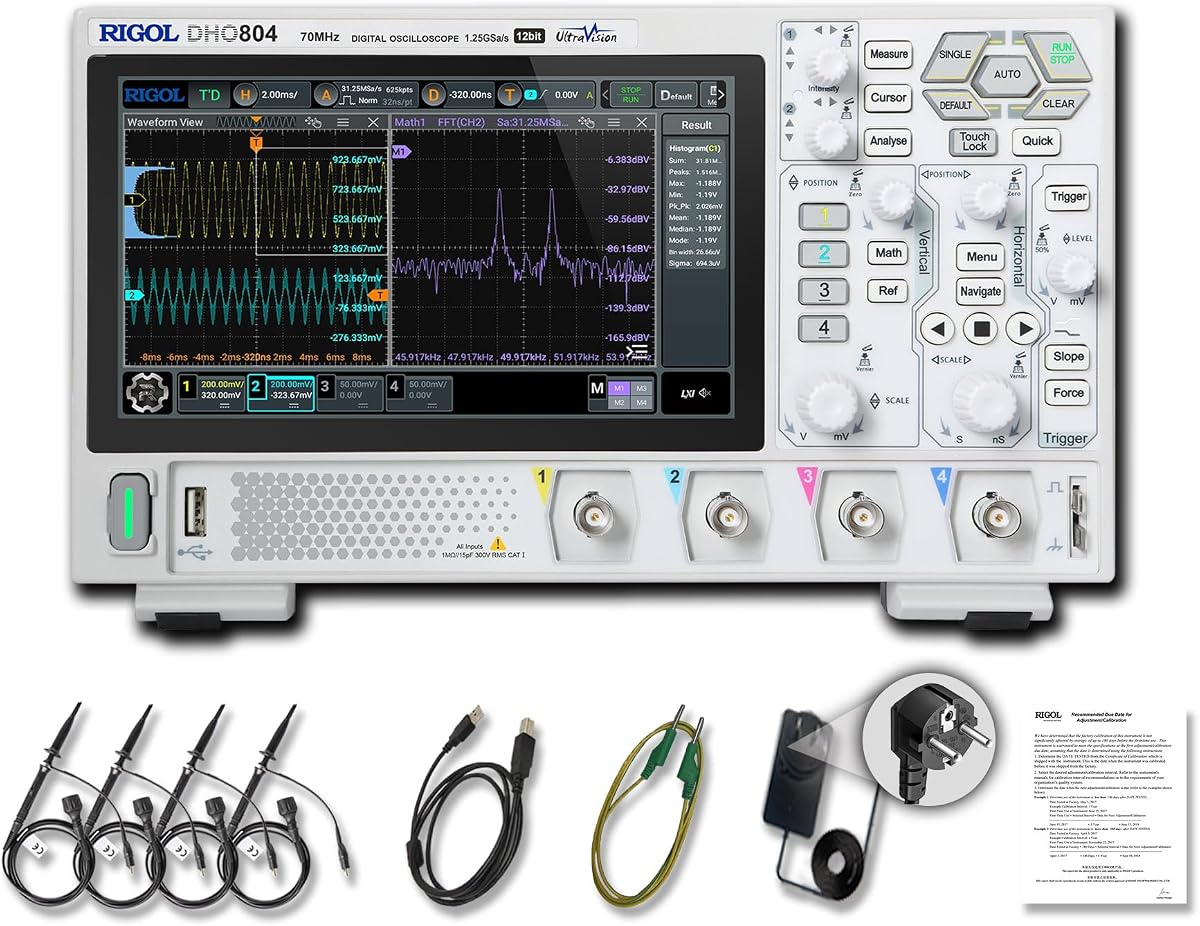
The RIGOL DHO804 stands out as a versatile portable digital oscilloscope designed for modern electronics work. It combines a 70 MHz bandwidth with four analog channels and a high 12-bit vertical resolution.
We may earn a commission when you buy through this link, at no additional cost to you.
Its UltraAcquire technology captures up to one million waveforms per second, making it easier to spot intermittent glitches. The 7 inch touchscreen and Flex Knob simplify navigation through complex signal data efficiently.
While the price point is higher than budget options, the depth of features justifies the cost for serious users. The memory depth and decode options support detailed analysis of embedded systems and protocols.
Engineers and students alike will find this device reliable for daily bench tasks. It is a strong recommendation for anyone needing precise vertical detail without sacrificing portability.
The 12-bit resolution allows you to see small voltage changes on power rails that 8-bit scopes miss.
Built-in serial decoding for CAN, RS232, and I2C helps troubleshoot communication buses quickly.
We may earn a commission when you buy through this link, at no additional cost to you.
The RIGOL DHO924S is a premium option for users needing more bandwidth and advanced features. It offers 250 MHz bandwidth with four analog channels and includes a built-in arbitrary function generator.
We may earn a commission when you buy through this link, at no additional cost to you.
The S model specifically adds Bode plot analysis, which is crucial for loop stability testing in power electronics. This capability usually requires external equipment, saving money on separate tools.
The deep memory depth allows you to capture long sequences without losing sample rate. Remote control features enable automation and documentation for professional lab environments effectively.
For advanced designers and researchers, this scope provides the performance needed for high-speed validation. It is the top choice for those who need integrated test capabilities.
This feature simplifies frequency response testing for control loops without extra hardware.
LAN and SCPI commands support web control and scripting for automated test setups.
We may earn a commission when you buy through this link, at no additional cost to you.
The FNIRSI DPOS350P is a 4-in-1 device that combines an oscilloscope, spectrum analyzer, frequency response analyzer, and signal generator. It offers 350 MHz bandwidth which is impressive for a portable unit.
We may earn a commission when you buy through this link, at no additional cost to you.
The integrated spectrum analyzer helps identify EMI issues and signal harmonics without needing a separate device. The frequency response analyzer is useful for tuning analog filters and loop stability tests.
While the bandwidth is high, the unit is handheld and battery-powered, making it ideal for field work. The 7 inch touchscreen provides a clear view of complex waveforms and measurements.
Techs who need multiple tools in one package will appreciate this versatility. It balances performance and portability well for on-site diagnostics and troubleshooting.
The 4-in-1 design reduces the gear you need to carry for comprehensive signal analysis.
Built-in battery and USB-C charging make it suitable for remote or mobile testing.
We may earn a commission when you buy through this link, at no additional cost to you.
The RIGOL DS1102Z-E is a classic choice for entry-level users and educational labs. It features a 100 MHz bandwidth and two analog channels with a sample rate of 1 GSa/s.
We may earn a commission when you buy through this link, at no additional cost to you.
One of its standout features is the deep memory, which allows for long captures without slowing down the sample rate. This helps in observing both long timeframes and fine signal details.
The waveform capture rate of 30,000 wfms/s is sufficient to reveal intermittent glitches in many circuits. Serial decoding support adds value for debugging common communication protocols like UART and SPI.
For students and hobbyists, this scope offers reliability and performance at a reasonable cost. It remains a highly recommended option for general electronics debugging tasks.
Deep memory lets you zoom in on long acquisitions without losing timing resolution.
The intuitive interface and standard features make it perfect for teaching signal basics.
We may earn a commission when you buy through this link, at no additional cost to you.
The FNIRSI 2C53T is a 3-in-1 device that combines a 50 MHz oscilloscope with a multimeter and signal generator. It is an excellent budget choice for basic maintenance and hobbyist projects.
We may earn a commission when you buy through this link, at no additional cost to you.
The integrated multimeter allows you to measure voltage, current, and resistance alongside waveforms. This reduces the need to switch tools when diagnosing simple circuit issues on the go.
The signal generator supports basic waveform output up to 50 kHz, which is useful for testing audio or low-frequency circuits. The unit is battery powered and features a compact size for easy transport.
While it lacks the bandwidth of higher-end models, it covers many common use cases well. It is a practical choice for those who need a versatile toolkit without a high price.
Having a multimeter inside saves time when checking DC values while viewing AC signals.
The low cost makes it accessible for students or anyone new to electronics diagnostics.
We may earn a commission when you buy through this link, at no additional cost to you.
The FNIRSI DSO152 is a handheld oscilloscope designed for basic signal observation and troubleshooting. With a 200 kHz bandwidth, it is suitable for audio and low-frequency digital signals.
We may earn a commission when you buy through this link, at no additional cost to you.
Its pocket-sized form factor makes it easy to carry around for field work or quick checks. The one-key auto setting simplifies operation for users who do not want complex manual adjustments.
It features a 2.8 inch HD LCD display that provides clear visibility of waveforms. The built-in battery supports several hours of continuous use, reducing downtime during tests.
For hobbyists or maintenance technicians who need a simple visualizer, this is a great starting point. It is best used for educational purposes or verifying basic signal presence.
Simple auto setup means you can see a waveform almost instantly after connecting the probe.
Its small size and light weight allow it to fit easily in a tool bag or pocket.
We may earn a commission when you buy through this link, at no additional cost to you.
The Hantek DSO2D15 is a cost-effective oscilloscope suitable for educational labs and general testing. It offers a 150 MHz bandwidth and two channels with various trigger modes.
We may earn a commission when you buy through this link, at no additional cost to you.
Support for multiple serial protocol triggers and decodes helps in understanding embedded system communication. This feature is valuable for learning how data is transmitted across buses like UART and SPI.
The arbitrary waveform output allows you to generate custom signals for testing responses in circuits. It serves well as a commissioning instrument for various fields including communication and research.
For schools or startups needing a balance of features and budget, this model fits well. It provides the necessary tools for learning signal analysis without a steep investment.
Protocol decodes and trigger modes help students understand complex digital communication clearly.
The ability to generate custom waves supports testing circuit behavior under specific conditions.
We may earn a commission when you buy through this link, at no additional cost to you.
The FNIRSI 1013D Plus is a portable oscilloscope featuring a large 7 inch touchscreen interface. This design makes it easy to navigate settings and view waveforms clearly.
We may earn a commission when you buy through this link, at no additional cost to you.
It offers 100 MHz bandwidth and a sampling rate of 1 GSa/s for accurate signal capture. The device includes a 1 GB storage space to save up to 1000 screenshots and waveform sets.
The capacitive screen supports gesture operations for cursor measurements and zooming. A built-in battery allows for several hours of use, making it suitable for mobile testing tasks.
For users who prefer touch controls over physical buttons, this is a strong contender. The combination of portability and display size enhances workflow efficiency in many scenarios.
Touch and gesture controls make adjusting cursors and zooming waveforms much faster.
Ample storage allows you to keep detailed records of tests without needing a PC.
We may earn a commission when you buy through this link, at no additional cost to you.
This product entry currently lacks available data in our system. We will update this section once specifications become available.
We may earn a commission when you buy through this link, at no additional cost to you.
Check back later for detailed information regarding its features and performance.
It is not recommended to purchase based on limited information.
Refer to other options in this guide for reliable choices.
We may earn a commission when you buy through this link, at no additional cost to you.
Selecting the right digital oscilloscope depends on your specific testing needs and budget. This guide covers key factors to consider before making a purchase.
Bandwidth determines the maximum frequency signal the scope can measure accurately. A general rule is to choose a scope with at least three times the highest signal frequency.
Ensure your selected model has sufficient bandwidth to avoid distorted waveforms and measurement errors.
Sampling rate is how many samples per second the scope can take. Higher rates provide more detail and prevent aliasing when viewing high-speed signals.
Look for a real-time sampling rate that exceeds the bandwidth requirement for your application.
Vertical resolution refers to the number of bits the ADC uses to digitize the signal. 12-bit scopes offer finer detail than standard 8-bit ones, which is vital for power supply testing.
Higher resolution helps you see small voltage changes that might otherwise be missed.
Most scopes offer two or four analog channels. Four channels allow you to view multiple signals simultaneously which is useful for differential measurements.
Choose four channels if you need to compare multiple rails or timing signals at once.
Memory depth is the amount of data the scope can store for a single capture. Deep memory allows long captures without losing sample rate detail.
Deep memory is essential if you need to inspect rare events or long timeframes.
Connectivity options like USB, LAN, or HDMI help you transfer data and control the scope remotely. These features improve workflow efficiency in lab environments.
Ensure the scope has ports compatible with your computer or automation software.
Handheld oscilloscopes are great for fieldwork and remote debugging. They usually run on batteries and are lighter than benchtop models.
If you need to move often, consider a portable unit with good battery life.
Advanced scopes include features like serial protocol decoding and math functions. These tools help analyze complex digital protocols without extra gear.
Check for protocol support matching your system such as I2C SPI or UART.
Always calibrate your probes before taking measurements to ensure accuracy. Use the probe compensation signal on the scope to adjust the probe settings properly.
Keep the device in a dry and dust-free environment when not in use. Avoid dropping the scope or applying excessive force to the input connectors.
Regularly update the firmware to access the latest features and fixes. This ensures the device remains reliable and compatible with new standards over time.
You generally need a scope with bandwidth at least three times higher than the highest signal frequency you plan to measure. For digital signals, this helps maintain accurate rise time and signal integrity.
Connect the probe to the compensation output on the scope and display the square wave. Adjust the trimmer on the probe until the square wave edges are flat and not rounded.
12-bit resolution provides more detail in the vertical axis allowing you to see smaller voltage changes. This is especially useful for measuring noise or ripple on power supply rails.
You need four channels if you plan to view multiple signals simultaneously for comparison. For simple debugging, two channels are usually sufficient and more cost-effective.
Yes, oscilloscopes are excellent for viewing audio waveforms and frequencies. A scope with at least 20 kHz bandwidth can handle the full audible range effectively.
Battery life varies by model but typically ranges from 4 to 8 hours depending on usage. Brightness and connectivity features can impact actual runtime.
We have reviewed ten digital oscilloscope models ranging from handheld to benchtop systems. The RIGOL DHO804 stands out for its balance of performance and features.
Consider your specific needs such as bandwidth resolution and connectivity when making a decision. Budget options like the FNIRSI DSO152 are great for entry-level work.
Prices and availability change often so always verify current listings before purchasing. Choosing the right scope will improve your efficiency and measurement accuracy.