
ELEGOO 0.96 Inch OLED Display Screen Module
4.6Editor score
Self-luminous pixels
128×64 graphics
Four-wire I2C connection
This guide compares the top Arduino LCD Display modules for projects. We review 10 models with I2C OLED and TFT screens to help you choose the right screen.
Choosing the right display for your microcontroller project can be tricky. You need a screen that is easy to wire, readable in different lighting conditions, and compatible with your chosen board like Arduino or Raspberry Pi.
We compared ten popular modules based on connectivity, resolution, color support, and ease of use. Our analysis covers character displays, OLED panels, and graphical TFT screens to ensure you find the best fit for your needs.
Each pick highlights key features and real-world use cases to simplify your decision. Please note that availability and pricing may vary over time. Always verify the current specs before ordering to ensure compatibility with your specific setup.
4.6Editor score

4.5Editor score

4.4Editor score
The following table provides a side-by-side look at all ten models we reviewed. It highlights key specifications like interface type, resolution, and screen size to help you quickly identify the right module for your build.




This module stands out as a reliable choice for text-based projects. With a 4.5 star rating, users appreciate its straightforward interface and clear character display suitable for beginners and experts alike.
We may earn a commission when you buy through this link, at no additional cost to you.
The built-in potentiometer allows for easy contrast and backlight adjustment. The I2C interface saves GPIO pins by using just four wires which is ideal for complex projects with multiple sensors.
While it lacks color or graphics capabilities, this limitation is acceptable for simple data readouts. The blue display offers high contrast which makes it easy to read in various lighting conditions.
If you need a durable screen for displaying sensor data or clocks, this is a strong recommendation. It works well with Arduino and Raspberry Pi making it a versatile addition to your toolkit.
The I2C protocol minimizes wiring complexity by using only two data lines plus power and ground.
The blue backlight ensures text remains legible even in bright or dim environments.
We may earn a commission when you buy through this link, at no additional cost to you.
This set of three OLED modules offers exceptional value for prototyping. The self-luminous pixels provide deep blacks and vibrant colors without needing a separate backlight which saves power.
We may earn a commission when you buy through this link, at no additional cost to you.
The fixed yellow and blue zones are perfect for status indicators or menus. You can use the yellow band for alerts and the blue area for detailed readings which helps organize information effectively.
While the screen is small, it is sufficient for compact projects like wearable devices or robot dashboards. The I2C connection keeps your wiring tidy and reduces the number of pins required.
For hobbyists looking to build multiple projects or want spares, this pack is an excellent choice. It is compatible with most common platforms and includes wires for immediate use.
OLED technology consumes less power than traditional LCDs since each pixel emits its own light.
The high contrast ratio ensures text and graphics are sharp and easy to read.
We may earn a commission when you buy through this link, at no additional cost to you.
This shield transforms your Arduino into a powerful interface device. With a 2.8-inch screen and touch support, it enables interactive menus and graphical displays suitable for advanced projects.
We may earn a commission when you buy through this link, at no additional cost to you.
The SD card slot allows you to store images and assets directly on the module. This feature is useful for projects that need to display stored media without relying on limited internal memory.
Using a stylus for touch input adds precision which is helpful for calibration screens or gaming interfaces. However, the parallel interface does require more pins than I2C alternatives.
If you need a rich visual experience with touch interaction, this is the top choice. It is designed specifically for Arduino Uno style headers making integration straightforward for many users.
Resistive touch allows users to interact with buttons and sliders directly on the screen.
MicroSD expansion lets you load textures and data without using microcontroller RAM.
We may earn a commission when you buy through this link, at no additional cost to you.
This pack offers a convenient solution for text display needs. The I2C protocol reduces I/O port occupation which is crucial for projects with limited GPIO pins available on your board.
We may earn a commission when you buy through this link, at no additional cost to you.
The blue backlight provides clear visibility for text and numbers. A potentiometer on the back allows you to adjust contrast so you can find the perfect setting for your environment.
It is compatible with a wide range of development boards including Arduino and Raspberry Pi. This versatility makes it a good fit for diverse DIY maker projects and IoT applications.
For users needing reliable text output without complex graphics, this module is ideal. The 2-pack provides a backup option which is useful if you build multiple units or need replacements.
Using I2C frees up digital pins for other sensors or actuators in your circuit.
A simple screw adjustment lets you tweak the brightness to match ambient light levels.
We may earn a commission when you buy through this link, at no additional cost to you.
This module integrates a new type of conversion circuit for better stability. The 1602 screen displays two lines of characters clearly which is perfect for logging data or showing simple menus.
We may earn a commission when you buy through this link, at no additional cost to you.
Freenove provides example projects and code online which speeds up development. While there is no paper tutorial, the digital resources are accessible and cover mainstream controllers like ESP32 and Pico.
The I2C interface saves ports compared to parallel connections. This feature is beneficial for compact builds where space and wiring complexity are major concerns for the designer.
If you are building multiple units or need a stable display for sensors, this is a great choice. The 2-pack offers flexibility and the support team is ready to assist with technical questions.
Access to sample code helps beginners get started quickly with minimal setup time.
Works well with newer boards like Raspberry Pi Pico and ESP32 for modern projects.
We may earn a commission when you buy through this link, at no additional cost to you.
This module is designed for ease of use with a dedicated library. The four-wire connection keeps your breadboard tidy and reduces the chance of wiring errors during initial setup.
We may earn a commission when you buy through this link, at no additional cost to you.
The included I2C LCD1602 library allows you to call functions directly without managing low-level protocols. This abstraction layer simplifies coding and lets you focus on your project logic.
A potentiometer is included to adjust backlight and contrast. This ensures the text remains readable regardless of the lighting conditions in your workspace or enclosure.
For those who want a quick start without deep diving into driver code, this is a strong option. It is tested with Arduino and Raspberry Pi making it accessible for most hobbyists.
Pre-built software makes integrating the display into your code fast and straightforward.
Clear pin labels help prevent confusion when connecting power and data lines.
We may earn a commission when you buy through this link, at no additional cost to you.
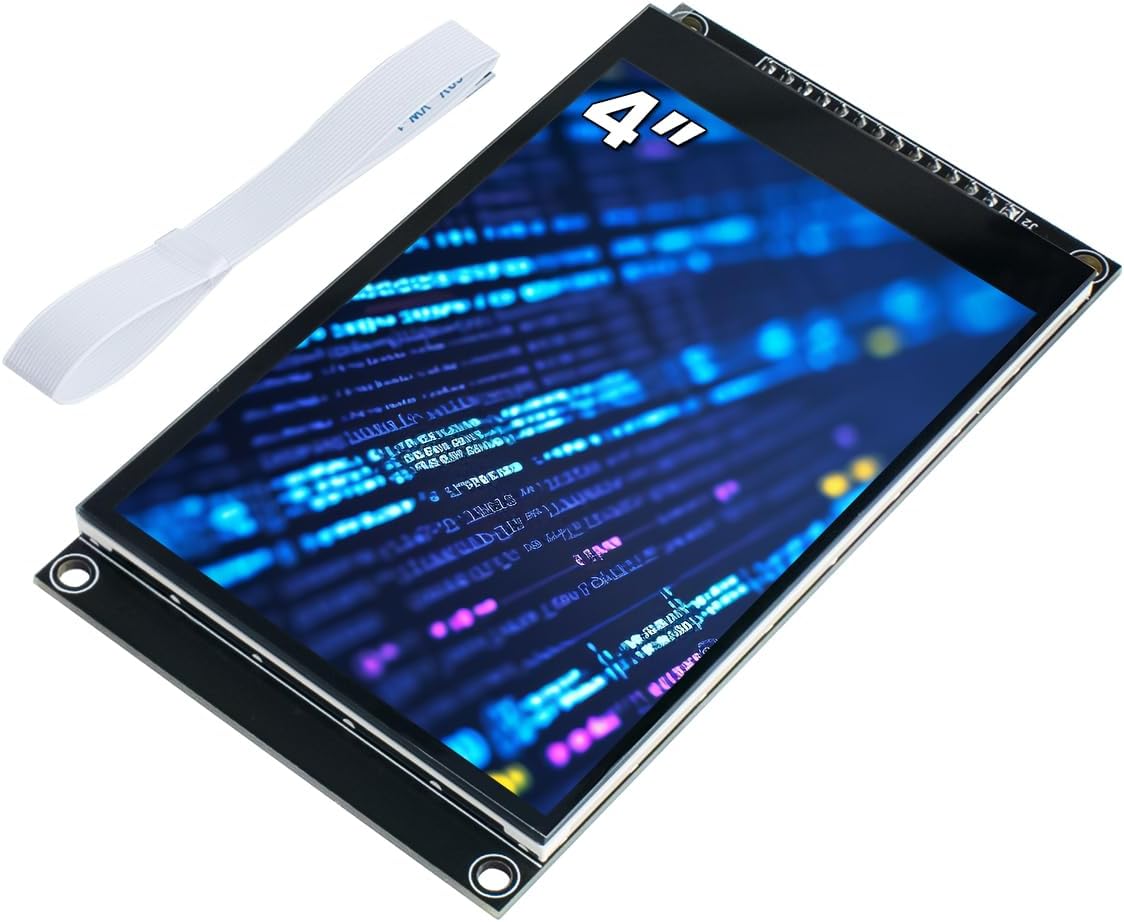
This module offers a large 4-inch display which is rare in this category. The capacitive touch panel is more responsive and accurate than resistive alternatives making it feel modern.
We may earn a commission when you buy through this link, at no additional cost to you.
With a resolution of 320×480 you can display detailed graphics and icons. It supports 65K colors which enhances visual feedback for interfaces that need rich imagery.
However, the lower rating suggests some users may face compatibility challenges. Ensure you check voltage levels as the module supports 5V and 3.3V MCUs but may need attention.
For projects needing a larger touch interface like kiosks or control panels, this is worth considering. It includes example learning programs for various controllers to aid development.
Capacitive touch responds to light finger touches and feels more natural than older types.
High pixel count allows for sharper text and more detailed visual representations.
We may earn a commission when you buy through this link, at no additional cost to you.
This bulk pack provides five modules ideal for large scale deployments. The 0.96 inch OLED screen is compact and consumes very little power during normal operation.
We may earn a commission when you buy through this link, at no additional cost to you.
The self-luminous nature means no backlight is required. This results in ultra-high contrast and clear dots which remain visible even in direct sunlight or dark settings.
Users can create custom fonts using software since none are embedded in the controller. This flexibility allows for unique character sets or symbols in your projects.
If you need multiple screens for classroom demos or large product runs, this option is efficient. The SSD1306 driver is well supported with libraries available for most platforms.
Low power usage makes these suitable for battery-operated devices like wearables.
The bright dots ensure readability from wide viewing angles up to 160 degrees.
We may earn a commission when you buy through this link, at no additional cost to you.
This 2-inch module delivers vibrant colors with its IPS screen. The 240×320 resolution provides a sharp image suitable for detailed UI elements or small diagrams.
We may earn a commission when you buy through this link, at no additional cost to you.
Operating voltage can be 3.3V or 5V but consistency is key. Ensuring logic levels match is essential to avoid communication errors or potential damage during operation.
The SPI interface requires minimum GPIOs which is beneficial for compact builds. It supports 262K colors making visuals rich and realistic for handheld devices or small dashboards.
If you need a colorful small screen for portable projects, this is a solid pick. Its compact dimensions fit easily into enclosures without adding bulk to the final product.
IPS technology offers wider viewing angles and more accurate color reproduction than TN.
Using SPI reduces the number of pins needed compared to parallel display interfaces.
We may earn a commission when you buy through this link, at no additional cost to you.
This pair of displays offers high quality with a strong 4.7 star rating. The 2-inch IPS panel ensures excellent brightness and wide viewing angles for clear visibility.
We may earn a commission when you buy through this link, at no additional cost to you.
The ST7789V controller supports SPI communication which reduces IO pins needed. This simplifies hardware design and makes integration easier for boards like ESP32 and STM32.
Pin labels are clearly marked for easy setup. This prevents connection errors and speeds up your prototyping phase significantly during development.
For versatile projects needing reliable visual output, these are a great choice. They work well with 3.3V and 5V logic making them adaptable to different microcontroller ecosystems.
Clear pin labeling helps beginners connect power and data lines correctly on the first try.
IPS panels provide better color accuracy and viewing angles compared to standard TFTs.
We may earn a commission when you buy through this link, at no additional cost to you.
Selecting the right display involves balancing technical specs with your project needs. We break down the key factors to consider before making your purchase.
Character displays show text only while graphical displays allow images. Decide if you need simple numbers or full graphics for your application.
Choose character for simple data and graphical for complex interfaces.
Higher resolution means sharper text and graphics but often requires more processing power. Match the resolution to the amount of detail you need to show.
Balance detail needs with the processing limits of your microcontroller.
I2C uses fewer pins than parallel interfaces. SPI offers faster data transfer. Check your board's available pins and speed requirements before choosing.
Use I2C for simplicity and SPI for speed if resources allow.
Most modules run on 5V or 3.3V. Ensure your power source matches the module voltage to prevent damage. Some have logic level converters built-in.
Always verify voltage requirements to ensure safe operation.
Touch screens enable interactive menus without physical buttons. Capacitive touch is more responsive than resistive but may cost more.
Consider touch if you need direct user interaction with the display.
Self-luminous OLEDs do not need a backlight which saves power. LCDs use LEDs for illumination. Choose based on your power budget and contrast needs.
OLED saves power while LCDs are often brighter in direct sun.
Verify the driver chip and library support for your specific board. Some displays are optimized for Arduino while others work better with ESP32 or Raspberry Pi.
Check library availability to ensure software support for your setup.
Measure your enclosure space to ensure the display fits. Shields stack easily on boards while breakout boards require headers or soldering.
Match the form factor to your physical design constraints carefully.
Start by connecting the power and data lines according to the datasheet. Ensure you use the correct voltage to avoid damaging the delicate components inside the module.
Install the necessary software libraries for your chosen interface like I2C or SPI. Test a basic script to confirm the display is working before integrating it into your main project.
Keep the screen free from dust and direct sunlight to maintain visibility. If using an enclosure ensure it has ventilation to prevent heat buildup which can affect performance.
I2C uses two wires for data and saves pins making it simpler for small projects. SPI uses more wires but transfers data faster which is better for graphics and animations.
Some displays support both 3.3V and 5V natively while others need a converter. Always check the module specs to see if it handles logic levels directly.
Not directly because each device needs a unique address. You may need an I2C multiplexer if you want to connect more than one display to the same bus.
Check your power supply and ensure the connections are secure. The I2C address might be incorrect so verify the address in your code matches the hardware.
Most are compatible but some require specific libraries or more pins. Ensure your board has enough free pins to support the touch controller and display together.
Use anti-glare films or adjust the brightness. If possible place the display away from direct sunlight to improve readability.
We reviewed ten distinct options ranging from simple text screens to advanced touch interfaces. The top picks offer a balance of features and value for most common hobbyist needs.
Prioritize interface type and power requirements based on your board limitations. If you need interaction choose touch while simple data works well with character displays.
Remember to check current availability and specifications before purchasing. Technology evolves quickly so ensure the chosen module meets your project goals at the time of order.